CURRENT NEWS . . .
LETTER FROM THE CHIEF – April 17, 2026
The 2026 fire season is shaping up to be another challenging year, not only for Arizona, but for much of the Western United States. In Oracle, early moisture followed by above-average temperatures led to accelerated vegetation growth and early blooming. As conditions have shifted, winds are now drying out that growth, creating a significant amount of receptive fuel that sits there waiting to be consumed by any little spark.
One of the most effective tools we have as a community is education. Programs like Firewise and CERT along with initiatives such as Ready, Set, Go, the Emergency Notification System (ENS), and maintaining defensible space around your home, are critical components to survive a wildfire. However, simply having access to this information is not enough, it is essential that we understand it and how to apply it.
The Cody Fire tested our community and Fire District in unprecedented ways. It became the top priority in the State, and possibly the Nation. Even with extensive resources deployed, it remained a significant challenge to prevent the fire from re- entering Oracle. While several factors worked in our favor during those critical days, we cannot assume that will always be the case.
Preparation is key. The more proactive each of us is, the greater our collective ability to protect lives, property, and our community. MY advice to everyone is to BE ready so you don’t have to GET ready, take Firewise seriously, sign up for emergency notifications, stay informed, get involved, and share information with others.
. . . . . . . . . . . . . . Robert Jennings – Oracle Fire District Fire Chief
ORACLE BRUSH DUMP BURN – On Saturday, APRIL 18, 2026,
OFD did a successful burn at the Oracle brush dump. We will let you know when it is open for regular visits. Thank you for your cooperation.
UPCOMING WILDFIRE PREPAREDNESS DAY!
If you have a resident card for Oracle Fire District, please join us on Saturday, May 2, 2026 for our annual FREE BRUSH DAY! Hours are from 7:45am-2:45pm. A valid residency card or contractor's permit can be obtained at the fire station in advance if you do not have one. (Please bring proof of residency!)
RULES: Only tree and shrub trimmings, grass cuttings and leaves are accepted. Tree trunks over 10” in diameter, tree stumps, cactus, agaves, or yuccas are NOT accepted as they do not burn completely. NO trash, lumber or construction materials, pallets, etc.
BRUSH DUMP STATUS . . .
We will make room to accommodate the 100+ loads expected on the Free Brush Day. However, the Brush Dump will remain closed until weather conditions permit a safe burn. OFD appreciates your patience during this closure of the Oracle Brush Dump. We look forward to seeing you on May 2, 2026.
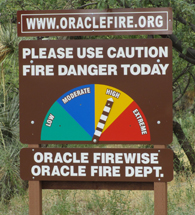
FIRE DANGER STATUS – Please note, Coronado National Forest (CNF) has changed our fire danger status to HIGH. The status sign is located on the right side just before you get to the Oracle Post Office.
CHIEF JENNINGS IN THE NEWS!
Oracle Fire Chief Robert Jennings was recognized with the 2025 Civic Engagement Award by District 4 Pinal County Supervisor Jeff McClure for “making a positive difference in the community.” Chief Jennings has dedicated many years of commitment to the Oracle Fire District and the Oracle community. He was instrumental in communicating with the residents of Oracle during the Cody Fire in May 2025 with his leadership and construction crews through multiple road closures. Supervisor McClure attended the Oracle Fire District Board meeting on Jan 20, 2026 to personally present the award and challenge coin to Chief Jennings. (Per the San Manuel Miner, Dec 2025 edition. – photos courtesy T.C. Brown)

2025 ORACLE FIREWISE PROPERTY AWARDS – Every year Oracle Firewise & Certs present firewise awards to property owners in Oracle to those that have reduced vegetation along with trimming, weed-eating, reduced ladder fuels – and have defensible space around their business or residence. The latest winners of that presentation are: Commercial Property: Simply Sandwiches located on American Ave. Private Residence: Doug Johnson on Azure Sky Road.
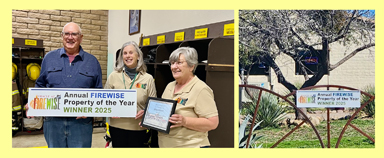
photo (left): Doug Johson (left with Firewise cochairs Rachel Opinsky and Mary Harris; (right): Front of Simply Sandwiches on American Ave. Congratulations to all
and a big thank you for keeping us safer!
Per the San Manuel Miner, Dec 2025 edition:
REP CISCOMANI VOTES YES ON HOUSE FUNDING BILL INCLUDING FUNDS FOR ORACLE BRUSH DUMP – Congressman Juan Ciscomani was proud to vote yes on the goverment funding bill for Oracle Fire District to purchase a new Air Curtain Burner. This investment will improve safety, efficiency and air quality for Oracle and will bring more tex dollars back to Arizona.
THE ORACLE BRUSH DUMP IS NOT OPEN YET! – Oracle Fire District will notify you as soon as the Oracle Brush Dump resumes regular business hours: Tues-Saturday, 8am-4:45pm. Closed on Sundays, Mondays and Holidays.
You must present an Oracle resident card at the window to use the brush dump. If you do not have one, please come into the front office Tues-Fri, with proof of Oracle residency within the Oracle Fire District.
Fees are as follows:
• one truck or small trailer = $5
• one truck AND a small trailer = $10
• one trailer over 10’ = $10 one dump truck = $20
EXACT CHANGE IS REQUIRED!
Accepted: only tree trimmings, brush, leaves and grass.
Not Accepted: tree stumps, cactus, agaves or yuccas, lumber, and any garbage. Call 520-896-2980 Mon-Fri if you have questions.
ORACLE GETS HELP FOR CLEANUP OF CODY LOOP –
The Town of Oracle received some visitors called Team Rubicon for several days to help clean up months after the devastating Cody Fire. The sound of chainsaws was the noise Mark Ramirez has been waiting for. “We couldn’t have asked for anything better and they’re not charging us a cent,” Ramirez said. Dozens of volunteers from across the country on Team Rubicon have begun scattering around Oracle, helping victims of the Cody Fire from back in May that devastated six homes.
Coronado National Forest status – Check updates on the CNF webpage regarding closures that will affect access to the National Forest and passage along the Arizona Trail.
ROAD CLOSURES – Official road closures are available at https://az511.gov. Please refer to OFD Facebook and website, Watchduty.org and the Watch Duty app for updates.
ADDITIONAL INFORMATION from the Watch Duty app provides timely and accurate information with WIldfire Maps & Alerts.
ORACLE EVACUATION MAP – Don't know what your Zone # is in case of evacuation? Click HERE to check your zone number after finding your nearest address location.
SIGN UP FOR PENS! – This is a great opportunity for residents everywhere in the county to sign up for the
Pinal Emergency Notification System at this link:
https://www.pinal.gov/1335/PENS---Pinal-Emergency-Notification-Syst
NOTICE: Coronado National Forest |
Stage II Fire Restrictions and Emergency Recreational Shooting Closure Order -
US Forest Service –
Coronado National Forest is NOW in Stage ll Fire Restrictions. Forest Order. The purpose of this Order is to protect public health and safety, as well as National Forest System lands, resources, and facilities, by reducing the risk of human-caused wildfires during the current period of high fire danger and severe fire weather conditions.
www.fs.usda.gov
Pinal County News – Burn Permits in Pinal County:
There will be no open burn permits until "further notice." Check with PinalCounty.gov for futher information.
BRUSH DUMP INFORMATION . . .
THE ORACLE BRUSH DUMP HAS NOT REOPENED AS YET! –
Oracle Fire District will resume regular business hours soon:
Tues-Saturday, 8am-4:45pm. Closed on Sundays, Mondays and Holidays.
You must present an Oracle resident card at the window to use the brush dump. If you do not have one, please come into the front office Mon-Fri, with proof of Oracle residency within the Oracle Fire District.
Fees are as follows:
• one truck or small trailer = $5
• one truck AND a small trailer = $10
• one trailer over 10’ = $10 one dump truck = $20
EXACT CHANGE IS REQUIRED! Accepted: only tree trimmings, brush, leaves and grass. Not Accepted: tree stumps, cactus, agaves or yuccas, lumber, and any garbage. Call 520-896-2980 Mon-Fri if you have questions.
Pinal County “Home Alone Unit” Program – Pinal County offers a program for people who would like a way to contact emergency response personnel quickly and efficiently in the event of emergencies. The program provides a medical alert system, for anyone who wants one, that can be used for any kind of emergency.
The system is comprised of a 911 pendant that can be carried around the home and activated in the event of an emergency, and a base unit that will automatically dial 911 when a button on the pendant is pushed. The pendant has a microphone that allows the user to communicate verbally with a 911 dispatcher. Additionally, it operates on caller ID so that even if voice communication with the dispatcher cannot be established, emergency response personnel will automatically respond to the address of the caller.
The program has been operational for at least 20 years and, over the years, has successfully notified first responders of many people in distress in the Oracle area.
The program in Oracle is administered by Oracle Fire District for residents within Oracle Fire District. The program was designed for elderly or handicapped people but is open to anyone who feels the need for an additional level of security within the home. The units are provided free of charge by the County, there is no monthly service charge, and are installed and maintained by a team of OFD volunteers. Routine checks, either in person or by phone, are made every six months to make sure the units are working properly. Users are also trained in how to check their units by themselves.
In most cases, the units are functional anywhere within the home and, nominally, within 100 feet of the house outside. One limitation is that the user must have a local “896” land line. The County has investigated possible ways to provide this service using cell or mobile phones but, as of now, has not found a way to do so.
Residents interested in the program, and who have a land line number (896 prefix), may inquire by contacting OFD
at 520-896-2980 (ask to speak with Tina or Cherie).
UP TO DATE WILDFIRE INFORMATION – Visit https://inciweb.wildfire.gov/ for up-to-date wildfire information.
For more info
on any fires
near Oracle or in AZ, click HERE or go to:
https://inciweb.wildfire.gov/incident-information/
You can also go onto Facebook to our Oracle Fire District link
(click on the right side of this page to facebook). We have information with updates from dffm.az.gov.
ORACLE BRUSH DUMP RESIDENT CARDS – If you have not yet registered for a resident card, please do so by coming to the fire station front office Tuesday through Thursdays from 8am-4:45pm. You will need "proof of residency" within the Oracle Fire District whenever you want to use the Brush Dump.
BRUSH DUMP BASIC RULES – NO TRASH, CONSTRUCTION MATERIALS, PALLETS, CACTUS, AGAVES, YUCCAS, TREE STUMPS OR TREE TRUNKS LARGER THAN 10” IN DIAMETER.
Normal brush dump hours are TUES–SAT, 8am–4:45pm, closed on holidays.
Oracle Brush Dump Rules – Regular business hours when open are Tuesdays-Saturdays 8:00am-4:45pm and closed Sundays, Mondays and Holidays.
• Please bring your resident card and exact change ($5 for a single truck or trailer, $10 for both, and $20 for a dump truck).
If you do not already have a resident card, please bring proof of residency within the Oracle Fire District, such as a driver's license or utility bill.
• As always, NO TRASH ALLOWED! This includes construction materials, even if it is wood. This is a Firewise program and designed to accept cuttings from trees, shrubs and grass. We cannot accept large tree stumps as they do not burn completely and need to be hauled away after burns. Also, NO CACTUS, AGAVES, AND YUCCAS. They also do not burn thoroughly. Thank you for your patience!
Fees are as follows:
• one truck or small trailer = $5
• one truck AND a small trailer = $10
• one trailer over 10’ = $10 one dump truck = $20
EXACT CHANGE IS REQUIRED! Accepted: only tree trimmings, brush, leaves and grass. Not Accepted: tree stumps, cactus, agaves or yuccas, lumber, and any garbage. Call 520-896-2980 Mon-Fri if you have questions.
OPTIONS . . .
There are options beside using the Oracle Brush Dump:
• One is the use of the Pinal County Waste Voucher Disposal Program* (more information below). The other is a link to many FREE Dump or Cleanup Events throughout Pinal County, two that will be in San Manuel. These will be posted on social media and the pinal county website.
Use of County Vouchers . . . Materials (like cactus, agaves, large tree stumps, construction lumber, etc) can be taken to our local Waste Management location using a Pinal County voucher.
Free vouchers are available through Pinal County: Eligible Cities: Aravaipa, Dudleyville, Kearny, Mammoth, Oracle, San Manuel, and Superior.
Waste Voucher Disposal Program Application –
1. Complete and return the Application:
Contact 520-866-6419 for the application or you can click HERE
or on this link for the application:
https://pinalcountyaz.seamlessdocs.com/f/wastewatervoucher
2. Submit the required documents:
Required Documents:
1. A current utility bill stating your name and residential service address. Acceptable Documents: Water, Power, Sewer & Trash Bill.
2. A copy of a valid State Issued ID/Driver’s License.
Voucher pickup information will be provided by Public Works once the application has been approved.
Three vouchers are issued to the primary residence once per year. Valid voucher dates are July-Oct, Nov-Feb & March-June. Any lost vouchers will not be replaced.
BRUSH DUMP
POLICIES & PROCEDURES:
POLICIES:
• Use of the brush dump is limited to vegetation removed from properties within Oracle Fire District.
• As always, only tree & shrub trimmings, grass cuttings, and leaves are accepted. Tree trunks over 10” in diameter, tree stumps, cactus, agaves, or yuccas are NOT accepted as they do not burn completely. NO trash, lumber or construction materials, pallets, etc.
• Hours of operation are Tuesday through Saturday. 8am- 5pm (last key check out at 4:45pm).
• We are now closed on Sundays and Mondays and all Holidays.
• The key will NOT be given to anyone without proof of residency or a permit.
• Non-compliance with any policies or procedures may result in permission to use the brush dump being revoked.
PROCEDURES:
• Proof of residency (Driver License, utility bill, or property tax document) that shows that you own property within Oracle Fire District or are renting is required to complete a resident form and to obtain permits.
• New resident forms will only be issued by the OFD administrative staff, front office of the fire station, Mon-Thurs 8am-4pm, and Friday mornings 8am-noon.
• If you cannot make it to OFD during these admin. hours, email either Tina at tacosta@oraclefire.org or Cherie at ccheney@oraclefire.org or call 520-896-2980 during admin. hours for alternative methods.
• Once an Oracle resident form is completed, they will be issued a Resident card with their name and number, which can be shown at the front office for the brush dump key.
• For an Oracle resident using a contractor to haul their brush, a sheet of 5 “permits"with your name and Resident ID # will be issued. The resident will be required to complete each permit with their name and phone number. When needed, the resident will fill in the contractor’s name and phone number on the permit and give one permit to them. More permits may be issued on a case-by-case basis.
• The resident will show their card, or the contractor will give the permit to the person at the front window of the OFD station, and will be required to pay the appropriate fee . . .
• $5 for one load – back of truck OR trailer /• $10 for two loads – back of truck AND trailer /• $20 for a dump truck. /
Note: EXACT CHANGE IS REQUIRED.
DIRECT LINKS TO BURN PERMITS AND RESTRICTIONS –
We now have a new main link button (left) on this home page to these important sources regarding Burn Permits and Restrictions.
• Pinal County – BURN PERMITS and another for PERMITTED FIRES.
• Coronado National Forest – All info including Burn Permits.
• Dept. of Forestry & Fire Management (DFFM) – A direct
link to
FIRE RESTRICTIONS.
• For state, federal, and tribal fire restrictions visit their NEW website at
Arizona State Park: https://azstateparks.com
NEED HELP TO FIREWISE YOUR PROPERTY? – OFD is now accepting applications for a grant that may help you now or in the future. Click HERE to find out details.
Click HERE for the application. If you just need a list of landscapers and contractors that are available here in Oracle, click HERE for more information. Note: they do not work for OFD.
WILDFIRE INFORMATION – There is ONE WEBSITE that has the best information on all major fires in the US. Make this a bookmark for Arizona and any other state you may want to check on. The home page takes you to the most current and largest fires. It has maps, details and updates. For all fires in one state, click at the top right, choose your state and click GO. Click HERE to go to that site or bookmark the link: http://inciweb.nwcg.gov/
Facebook is also another good source for the latest information.
OFD IS RECRUITING! – Oracle Fire is recruiting for Part-Time and Reserve Firefighter/ EMTs. Paid 24-hr shifts. You must be at least 18. Click HERE to see our flyer with more details or email us at: rjennings@oraclefire.org / Click HERE for an APPLICATION.
PREPARING FOR WILDFIRE – Your future self may thank you for this: do these two things right now to prepare for wildfires. Not sure how? Click HERE.
GETTING ALERTS – If you have not yet turned in Oracle's ENS form to be added to the OFD emergency notification system, please fill out the form, complete and either email back to OFD (Tina), fax, or bring in. Don’t forget to sign up for the Pinal County Emergency Notification System as well. See more information below:
THE ORACLE EMERGENCY NOTIFICATION SYSTEM (ENS) –
You can't afford not to be on this list for emergency notifications. Click to go to the "ENS" form and be
sure to get any additional numbers (besides your landline) in the system by filling it out and returning it to
Oracle Fire District. Just drop it by the fire station.
PINAL COUNTY EMERGENCY NOTIFICATION SYSTEM (PENS) –
Pinal County offers another notification system called PENS besides our ENS system. You may request this one as well. Contact them to get on their list. It's completly free and to sign up you only need a phone number or email address.
HOME ALONE ENS SYSTEM – If you are in need of an earlier warning to evacuate due to your health or to relocate animals and livestock, you can be in a special group that gets ENS warningsfrom Oracle Fire ahead of the general public. Here's a LIST of evacuation information that may help you.
INTERESTED IN EVACUATION PREPARATION OR WILDFIRE STATUS? Here are some links and documents that will help you find the information you need:
• Ready, Set, Go - Information on One Less Spark, One Less Wildfire.
• How to Have a Firewise Home (606kB)
• Living with Wildfire (3.5MB)
• FEMA Evacuation Checklist (123kB)
• One Less Spark (Poster) (2MB)
• Newsletter - SUMMER
• EQUINE & LIVESTOCK EVAC PREP - Link to Video on youtube – Wildfire preparedness tips from a firefighter, veterinarian and ranch owner called "Saving the Ranch."
MORE INFORMATION – Would you like more useful info on wildfire?
Click HERE for News & Information, Fire Weather, Maps, WIldland Fire Data in Google Earth, Arizona Fire Ecology, WIldland Fire, Firewise Resources, Smoke and Air Quality, Info for Before, During and After a Wildfire, How to Help and Fire Prevention & Education topics. There are several excellent artlces relative under each topic you can click to at the Arizona Interagency Wildfire Prevention website.